If you are buying American gold, the choice usually comes down to two coins from the same mint: the American Gold Eagle and the American Gold Buffalo. Both are struck by the United States Mint, both hold exactly one troy ounce of pure gold, and both carry a $50 face value. So which U.S. Mint coin should you buy first?
The short answer: for most first-time buyers, buy the Gold Buffalo if you want pure .9999 gold at the lowest premium, and buy the Gold Eagle if you want the most recognized and liquid American coin — and whichever of the two is cheaper on the day you buy. The gold inside is identical — one troy ounce either way. What differs is the purity, the design, the durability, and usually a small gap in premium. This guide compares the American Gold Eagle vs Gold Buffalo across all five, so you can pick with confidence.
In This Guide
- American Gold Eagle vs Gold Buffalo at a Glance
- The American Gold Eagle: Design and Specs
- The American Gold Buffalo: Design and Specs
- Purity: 22 Karat vs 24 Karat — Does It Matter?
- Size and Feel in Hand
- Premiums: What You Actually Pay Over Spot
- Liquidity: Which U.S. Mint Coin Is Easier to Sell?
- Which U.S. Mint Coin Should You Buy First?
- How to Buy Your First U.S. Mint Gold Coin
- Frequently Asked Questions
American Gold Eagle vs Gold Buffalo at a Glance
| American Gold Eagle | American Gold Buffalo | |
|---|---|---|
| Mint | United States Mint | United States Mint |
| First issued | 1986 | 2006 |
| Gold content | 1 troy oz (31.103 g pure) | 1 troy oz (31.1035 g pure) |
| Purity | .9167 fine (22-karat) | .9999 fine (24-karat) |
| Gross weight | 33.93 g | 31.1035 g |
| Diameter | 32.7 mm | 32.7 mm |
| Thickness | 2.87 mm | 2.95 mm |
| Face value | $50 (US legal tender) | $50 (US legal tender) |
| Obverse design | Saint-Gaudens’ Liberty (1907) | Fraser’s Native American portrait (1913) |
| Reverse design | Eagle portrait by Jennie Norris (2021+) | American bison by Fraser |
| Sizes | 1, 1/2, 1/4, 1/10 oz | 1 oz (bullion) |
| Best for | Maximum liquidity, classic design | Pure gold, lower premium |
Both coins are U.S. legal tender, both are guaranteed by the U.S. government for weight and content, and both are among the most traded gold coins in America. On gold content alone, there is no winner — the American Gold Eagle vs Gold Buffalo decision comes down to everything around the gold.
The American Gold Eagle: Design and Specs
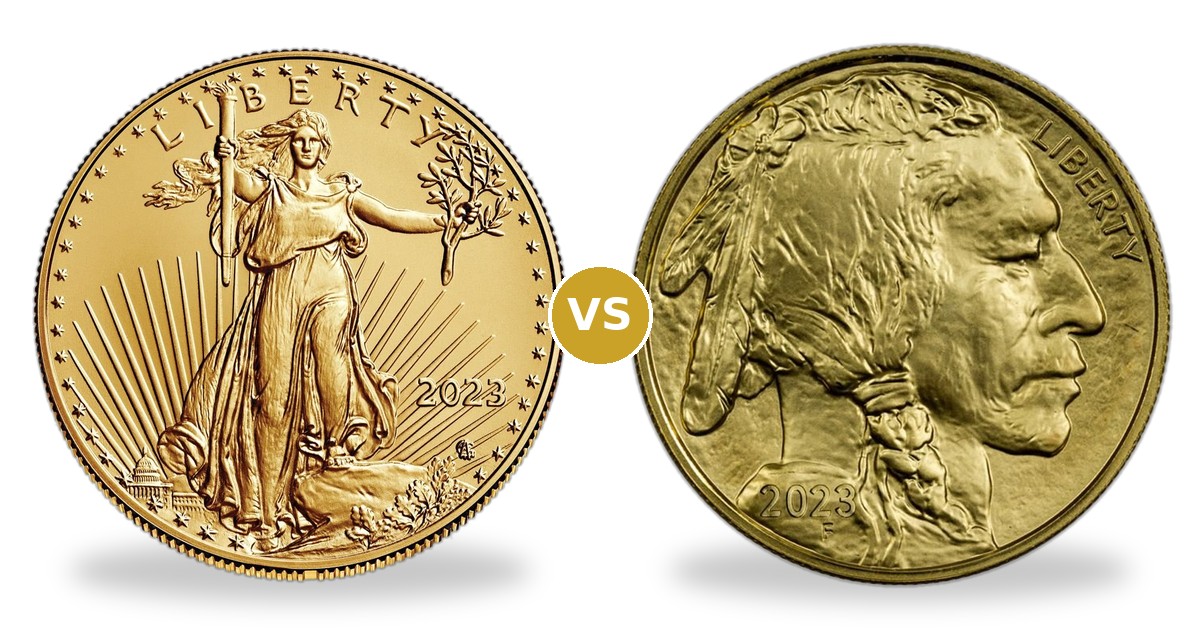
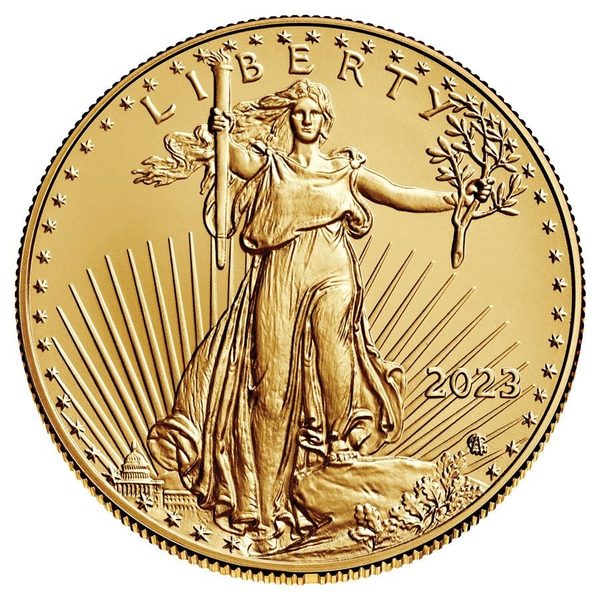
The American Gold Eagle is the best-selling U.S. gold bullion coin, first struck in 1986 under the Gold Bullion Coin Act of 1985. Its obverse is Augustus Saint-Gaudens’ striding Liberty, adapted from his 1907 $20 Double Eagle — widely considered the finest design ever used on American coinage. The reverse, since mid-2021, is Jennie Norris’ close-up eagle portrait (earlier issues show Miley Busiek’s family of eagles returning to the nest).
The Eagle’s defining feature is its alloy. It is struck in 22-karat gold — 91.67% gold, 3% silver, 5.33% copper, the same “crown gold” alloy used for American gold coinage until 1834. That is why a 1 oz Gold Eagle weighs 33.93 grams even though it contains only 31.103 grams of pure gold: the extra silver and copper add weight without reducing the gold content below one full troy ounce. The alloy makes the coin harder and more resistant to scratches and handling than pure gold — you can hold an Eagle without worrying about marking it.
One more practical point: the Gold Eagle is the only U.S. Mint bullion coin that comes in four sizes — 1, 1/2, 1/4, and 1/10 oz — so it is the natural choice if you want to buy fractional gold from the U.S. Mint. It is also IRA eligible by a specific exception in the law, even though its .9167 fineness is below the usual .995 minimum.
American Gold Eagle value and buying guide
The American Gold Buffalo: Design and Specs
The American Gold Buffalo is the U.S. Mint’s purest gold coin — and its newest. Authorized by the Presidential $1 Coin Act of 2005, it debuted in 2006 as the first 24-karat (.9999 fine) gold bullion coin ever issued by the United States, a direct answer to the .9999 coins other national mints were already selling. The first coins were struck at the West Point Mint on June 20, 2006, and went on sale two days later.
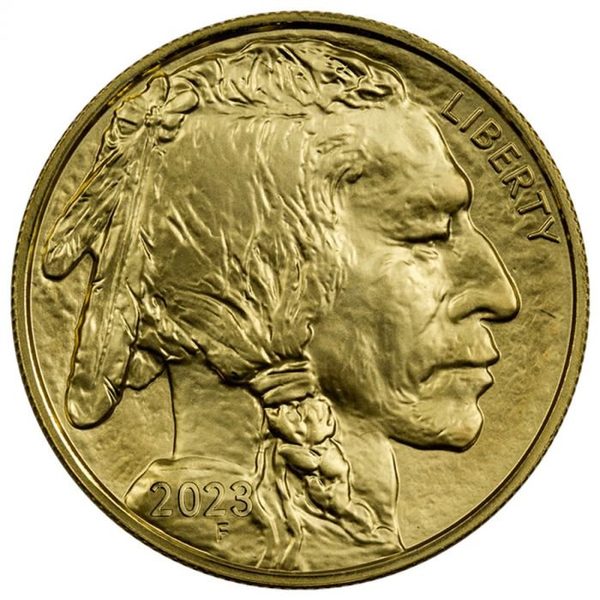
Both sides come from James Earle Fraser’s 1913 Buffalo Nickel, one of America’s most beloved coin designs: a Native American portrait on the obverse and an American bison on the reverse, with the legend “$50, 1 OZ .9999 FINE GOLD” beneath the bison. The Buffalo contains no alloy at all — its total weight of 31.1035 grams is entirely gold, which is why it weighs less than the Eagle despite holding the same ounce of pure gold.
That purity has a trade-off: .9999 gold is softer than the Eagle’s alloy, so a Buffalo scratches and dents more easily. Keep it in its capsule and handle it by the edges. Standard bullion Buffalos come in 1 oz only (fractional sizes were struck just once, in a 2008 proof set), and bullion strikes carry no mintmark — proof versions bear the “W” for West Point. Like the Eagle, the Buffalo is IRA eligible, comfortably above the .995 minimum.
American Gold Buffalo coin guide
Purity: 22 Karat vs 24 Karat — Does It Matter?
This is the question every buyer asks, and the honest answer is: for the gold, no; for the coin, a little.
Both coins contain exactly one troy ounce of pure gold. The Eagle’s .9167 fineness does not mean less gold — it means the same ounce of gold plus 2.83 grams of silver and copper for durability. When you sell either coin, a dealer pays for the ounce of pure gold inside, not for the fineness number on the label.
Where purity does matter:
- Handling: the Eagle’s alloy resists scratches; the Buffalo’s pure gold does not. If you plan to handle your coins, the Eagle is more forgiving. If they live in capsules, it makes no difference.
- Purity preference: some buyers simply prefer owning .9999 fine gold with nothing else in it. If that matters to you, the Buffalo is the only U.S. Mint choice.
- IRA rules: both are IRA eligible — the Buffalo by purity, the Eagle by a specific exception in the law.
Do not let anyone tell you the Eagle is “less gold” than the Buffalo. It is the same ounce, in a tougher package.
Size and Feel in Hand
Put the two coins side by side and they look the same size — both are 32.7 mm across, the same diameter by design. Pick them up and the difference is subtle: the Eagle is slightly heavier in hand at 33.93 grams against the Buffalo’s 31.10 grams, and a touch thinner (2.87 mm vs 2.95 mm). The Buffalo’s extra thickness comes from packing the same ounce of gold into a pure, unalloyed planchet.
In practice, the size difference matters not at all — both fit the same 32.7 mm capsules and tubes. What you will notice is the design: the Eagle’s Liberty is flowing and classical, the Buffalo’s portrait is bold and unmistakably American. Buy the design you want to look at, because you will own it for years.
Premiums: What You Actually Pay Over Spot
Neither coin sells at the spot price. You pay spot plus a premium — minting, distribution, and dealer margin — and for U.S. Mint coins that premium is typically a few percent over spot. The gap between the two coins is usually small, and it moves day to day.
As a rule of thumb, the Gold Eagle usually carries the slightly higher premium of the two — typically around 4–8% over spot for current-year bullion coins — because it is the best-selling U.S. gold coin and demand for it rarely lets up. The Gold Buffalo usually runs a little cheaper, in line with other .9999 coins. But “usually” is not “always”: on any given day, either coin can be the cheaper buy, and the gap is often within a percent or two.
That is why the honest advice for a first purchase is simple: compare the live price of both coins on the day you buy, and take the cheaper one. The gold is identical. A one-percent premium gap on a ~$4,000 coin is ~$40 — real money, and the only difference you will actually feel. Check the live prices in our shop before you decide.
Liquidity: Which U.S. Mint Coin Is Easier to Sell?
Both coins are about as liquid as American gold gets. Any bullion dealer in the United States will buy back a 1 oz American Gold Eagle or a 1 oz American Gold Buffalo, usually on the spot and close to the spot price. Neither coin needs an assay or a certificate to sell — the design and the U.S. Mint’s guarantee do that job.
If there is an edge, it belongs to the Eagle. It is the best-selling U.S. gold bullion coin, the one every dealer expects to see, and the one most likely to sell at the smallest discount to spot — especially outside the United States, where the Eagle’s fame travels further than the Buffalo’s. The Buffalo sells the same day at any serious dealer too, but the Eagle’s 40-year head start shows in resale. If you ever need to sell fast, the Eagle moves first — by a hair.
Which U.S. Mint Coin Should You Buy First?
There is no wrong answer between the American Gold Eagle vs Gold Buffalo — but there is a right answer for you:
- Buy the Gold Buffalo first if: you want pure .9999 gold, you prefer the lowest premium, you love the Buffalo Nickel design, and your coins will live in capsules anyway.
- Buy the Gold Eagle first if: you want the most recognized and liquid American coin, you like the Saint-Gaudens Liberty design, you want the toughest coin for handling, or you might want fractional sizes later.
- Buy both if: you are building a stack rather than making a single purchase. Many American buyers hold both — the Eagle as the liquid workhorse and the Buffalo as the pure-gold holding — and alternate depending on which is cheaper that month.
If you are still torn, here is the tiebreaker: look at today’s live prices for the 1 oz American Gold Eagle and the 1 oz American Gold Buffalo in our shop, and buy the cheaper one. Then, when you buy your second ounce, buy the other. You will own both of the U.S. Mint’s 1 oz gold coins, and you will have paid the lowest premium on each.
How to Buy Your First U.S. Mint Gold Coin
New to physical gold? The process is straightforward, and our complete guide to buying gold in 2026 walks through it in full — bars vs coins, premiums, dealers, and storage step by step. The short version:
- Check the live spot price first. Every legitimate dealer prices coins as spot plus premium. If you do not know spot, you cannot tell a fair price from a bad one.
- Compare the total price, not just the premium. Compare the out-the-door price of the exact coin across two or three reputable dealers.
- Buy from a dealer with transparent pricing, insured shipping, and a clear buyback policy. Avoid sellers with no phone number, prices far below everyone else, or pressure to wire money to a personal account.
- Verify on arrival. Check the coin matches what you ordered — correct weight, design, and packaging — and keep it in its capsule or tube. (Especially for the Buffalo: .9999 gold marks easily, so handle it by the edges.)
- Store it properly. A home safe works for a coin or two; for a growing stack, consider a bank safe deposit box or professional vault storage.
Frequently Asked Questions
Is the American Gold Eagle or the Gold Buffalo better?
Neither is objectively better — both are 1 oz of pure gold from the U.S. Mint. The Eagle wins on liquidity, durability, and design history; the Buffalo wins on purity and usually on premium. Buy the cheaper one on the day.
Is the American Gold Eagle pure gold?
It contains one full troy ounce of pure gold, but the coin itself is 22-karat (.9167 fine) — 91.67% gold with silver and copper added for durability. Its total weight is 33.93 grams.
Is the American Gold Buffalo pure gold?
Yes. The Gold Buffalo is .9999 fine (24-karat) — the only pure-gold bullion coin the U.S. Mint makes. Its total weight of 31.1035 grams is entirely gold.
Are Gold Eagles and Gold Buffalos IRA eligible?
Yes, both are. The Buffalo qualifies by purity (.9999, above the .995 minimum); the Eagle qualifies by a specific exception in the law for American Gold Eagles.
Which U.S. Mint gold coin has the lowest premium?
It changes day to day. The Gold Buffalo is often slightly cheaper than the Gold Eagle, but the gap is usually within a percent or two — always compare live prices before you buy.
Ready to Buy Your First U.S. Mint Gold Coin?
You have done the research — now put it to work. Whether you pick the Eagle’s liquidity and classic design or the Buffalo’s pure gold and lower premium, you are starting with one of the two best American gold coins in the world. Browse U.S. Mint gold coins in our shop — recognized mints, transparent pricing tied to live spot, and insured delivery on every order.
This article is for education only and is not financial advice. Gold prices move with the live spot market — always check the current price before you buy.