
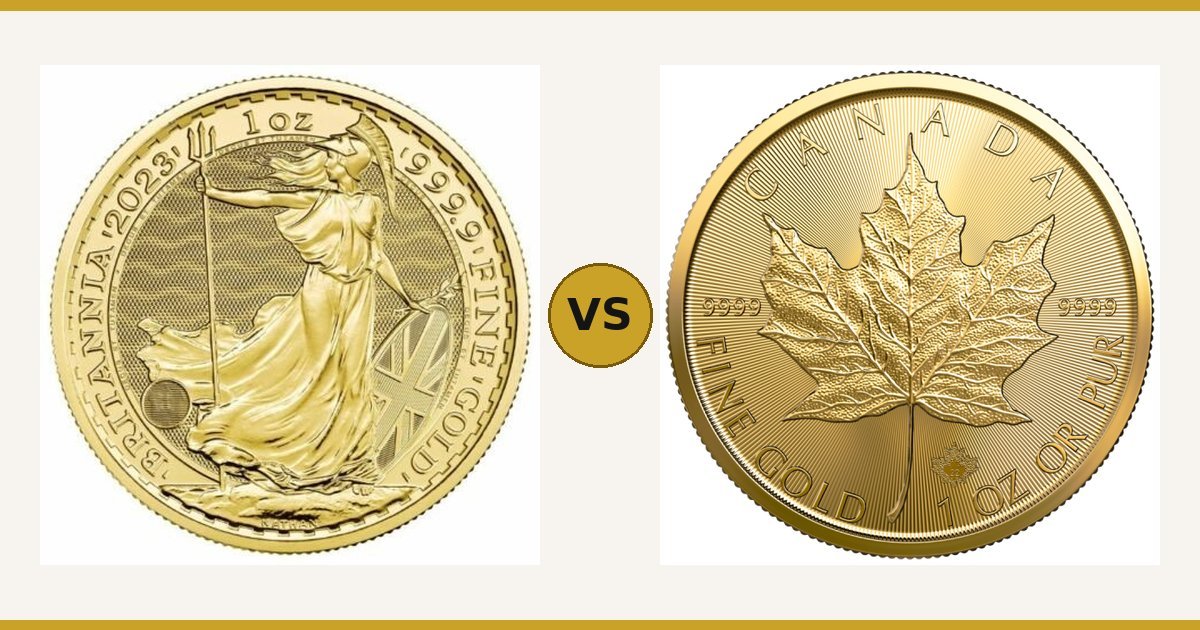
If you are buying your first ounce of gold, the choice usually comes down to two coins: the Gold Britannia from The Royal Mint and the Gold Maple Leaf from the Royal Canadian Mint. Both hold exactly one troy ounce of .9999 fine gold. Both are government-backed, globally recognized, and easy to sell. So which 1 oz gold coin should you buy first?
The short answer: for most first-time buyers, buy whichever of the two is cheaper on the day you buy. The gold inside is identical — one troy ounce of .9999 fine gold either way. What differs is the design, the security features, the size of the coin, and usually a small gap in premium. This guide compares the Gold Britannia vs Gold Maple Leaf across all five, so you can pick with confidence.
In This Guide
- Gold Britannia vs Gold Maple Leaf at a Glance
- The Gold Britannia: Design and Security
- The Gold Maple Leaf: Design and Security
- Size and Feel in Hand
- Premiums: What You Actually Pay Over Spot
- Liquidity: Which 1 oz Gold Coin Is Easier to Sell?
- Which 1 oz Gold Coin Should You Buy First?
- How to Buy Your First 1 oz Gold Coin
- Frequently Asked Questions
Gold Britannia vs Gold Maple Leaf at a Glance
| Gold Britannia | Gold Maple Leaf | |
|---|---|---|
| Mint | The Royal Mint (UK) | Royal Canadian Mint |
| First issued | 1987 | 1979 |
| Gold content | 1 troy oz (31.10 g) | 1 troy oz (31.103 g) |
| Purity | .9999 fine (since 2013) | .9999 fine (since 1982) |
| Diameter | 32.69 mm | 30.00 mm |
| Face value | £100 (UK legal tender) | $50 CAD (Canadian legal tender) |
| Reverse design | Britannia by Philip Nathan | Sugar maple leaf by Walter Ott |
| Security features | Latent image, surface animation, micro-text, tincture lines | Radial lines, micro-engraved privy, Bullion DNA |
| Best for | Design and security fans, UK buyers | Lowest premiums, North American buyers |
Both coins are .9999 fine gold, both are legal tender in their home country, and both are among the most traded 1 oz gold coins in the world. On gold content alone, there is no winner — the Gold Britannia vs Gold Maple Leaf decision comes down to everything around the gold.
The Gold Britannia: Design and Security
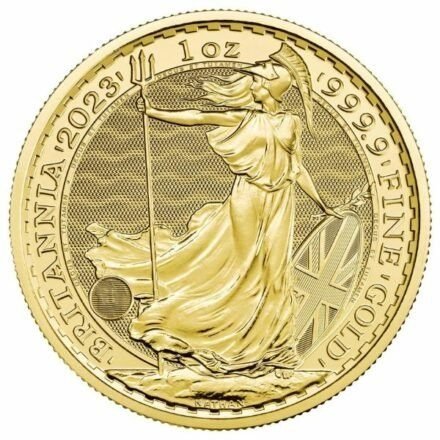
The Gold Britannia is The Royal Mint’s flagship bullion coin, first struck in 1987. The reverse shows Philip Nathan’s standing Britannia — trident in one hand, shield bearing the Union flag in the other — a design that has barely changed in nearly 40 years. The obverse on current issues shows the official coinage portrait of King Charles III by Martin Jennings.
What sets the modern Gold Britannia apart is security. Since 2021, every Britannia bullion coin has carried four visual security features, all checkable by eye with no equipment:
- Latent image: tilt the coin and the image below Britannia changes between a trident and a padlock.
- Surface animation: the wave pattern behind Britannia appears to move as you tilt the coin.
- Micro-text: the border carries the Latin motto “DECUS ET TUTAMEN” — an ornament and a safeguard.
- Tincture lines: fine lines pick out the Union flag on Britannia’s shield.
One thing to know: Britannias dated 1987 to 2012 were struck in 22-carat gold (.9167 fine), not .9999. They still contain a full troy ounce of gold, but they are heavier and slightly larger in gross weight. Any Britannia dated 2013 or later is .9999 fine. If you are buying a 1 oz Gold Britannia today, you are almost certainly getting a .9999 coin — but check the year if you are buying older stock.
For UK buyers there is a real tax perk: as UK legal tender, the Gold Britannia is exempt from Capital Gains Tax and from VAT as investment gold. For US buyers that perk does not apply, but the coin’s security features and worldwide recognition still count — a dealer anywhere in the world knows what a Britannia is.
The Royal Mint’s Britannia specifications page lists all four security features.
The Gold Maple Leaf: Design and Security
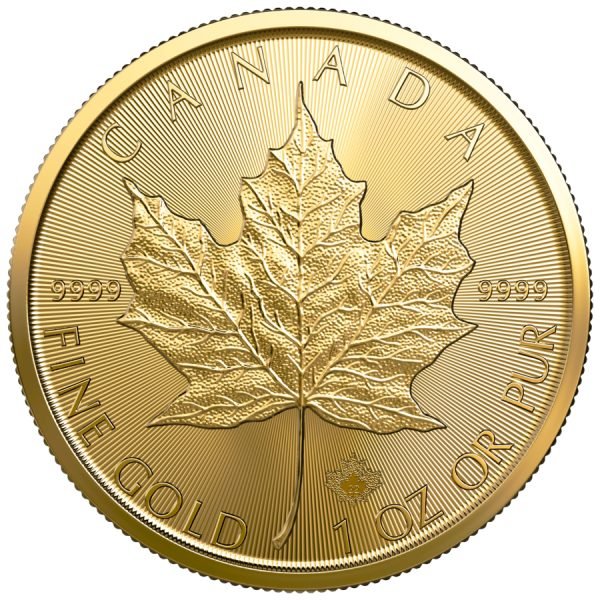
The Gold Maple Leaf is the older of the two coins, first struck by the Royal Canadian Mint in 1979, and it set the standard the rest of the industry followed: it was the first bullion coin to reach .9999 purity, in 1982, and more than 25 million troy ounces have been sold since. The reverse is Walter Ott’s sugar maple leaf, one of the most copied designs in bullion — and the reason the Mint keeps upgrading its security.
Every 1 oz Gold Maple Leaf dated 2013 or later carries three security features:
- Radial lines: precision-machined lines radiate across both faces, creating a light-diffracting pattern that is hard to copy.
- Micro-engraved privy mark: a tiny maple leaf, laser-engraved on the reverse, containing the last two digits of the year of issue — visible only under magnification.
- Bullion DNA: the Mint’s proprietary authentication technology, which lets dealers verify coins dated 2014 and later against the Mint’s own records.
The obverse portrait depends on the year: 2023 and earlier show Queen Elizabeth II (the 2023 issue carries the dates 1952–2022), while 2024 and later show King Charles III by Steven Rosati. The maple leaf reverse has not changed. Like the Britannia, the Gold Maple Leaf is IRA eligible — its .9999 purity is well above the .995 minimum.
All three security features are confirmed on the Royal Canadian Mint’s Gold Maple Leaf page.
Size and Feel in Hand
Put the two coins side by side and the difference is obvious: the Gold Britannia is wider and thinner at 32.69 mm across, while the Gold Maple Leaf is a more compact 30.00 mm. Both contain exactly the same ounce of gold — the Britannia just spreads it thinner.
In practice, the size difference matters in two small ways. The wider Britannia shows off its design better and its security features are easier to check by eye. The smaller, thicker Maple Leaf feels a little more substantial in hand and fits the standard 30 mm capsules and tubes most dealers stock. Neither is a reason to choose one over the other on its own, but if you plan to store coins in tubes, note that Britannia and Maple Leaf tubes are not interchangeable.
Premiums: What You Actually Pay Over Spot
Neither coin sells at the spot price. You pay spot plus a premium — the minting, distribution, and dealer margin — and for standard 1 oz gold coins that premium is typically a low single-digit percentage over spot. The gap between the two coins is usually small, often within a percent or two, and it moves day to day.
As a rule of thumb, the Gold Maple Leaf is often the slightly cheaper of the two for North American buyers, because the Royal Canadian Mint produces it in huge volumes and it is the default 1 oz coin on this side of the Atlantic. The Gold Britannia can carry a slightly higher premium outside the UK, where it is imported in smaller numbers. But “often” is not “always” — on any given day, either coin can be the cheaper buy.
That is why the honest advice for a first purchase is simple: compare the live price of both coins on the day you buy, and take the cheaper one. The gold is identical. A one-percent premium gap on a ~$4,000 coin is ~$40 — real money, and the only difference you will actually feel. Check the live prices in our shop before you decide.
Liquidity: Which 1 oz Gold Coin Is Easier to Sell?
Both coins are about as liquid as physical gold gets. Any bullion dealer in the US, Canada, or the UK will buy back a 1 oz Gold Britannia or a 1 oz Gold Maple Leaf, usually on the spot and close to the spot price. Neither coin needs an assay or a certificate to sell — the design and security features do that job.
If there is an edge, it is geographic. In North America, the Maple Leaf is the coin every dealer expects to see, so it can sell a fraction faster and a fraction closer to spot. In the UK and Europe, the Britannia holds the same home advantage. For a US buyer selling in the US, the Maple Leaf has the slighter edge — but the difference is small, and both coins sell the same day at any serious dealer. Buy the coin, not the exit plan: if you ever need to sell fast, either one moves.
Which 1 oz Gold Coin Should You Buy First?
There is no wrong answer between the Gold Britannia vs Gold Maple Leaf — but there is a right answer for you:
- Buy the Gold Maple Leaf first if: you want the lowest premium and the easiest resale in North America, you like the clean maple leaf design, and you want the coin with the longest .9999 track record.
- Buy the Gold Britannia first if: you love the Britannia design, you want the most visually checkable security features of any bullion coin, or you are buying from the UK, where it also carries tax advantages.
- Buy both if: you are building a stack rather than making a single purchase. Many buyers hold both — the Maple Leaf as the low-premium workhorse and the Britannia as the design-led holding — and alternate depending on which is cheaper that month.
If you are still torn, here is the tiebreaker: look at today’s live prices for the 1 oz Gold Britannia and the 1 oz Gold Maple Leaf in our shop, and buy the cheaper one. Then, when you buy your second ounce, buy the other. You will own both of the world’s best 1 oz gold coins, and you will have paid the lowest premium on each.
How to Buy Your First 1 oz Gold Coin
New to physical gold? The process is straightforward, and our complete guide to buying gold in 2026 walks through it in full — bars vs coins, premiums, dealers, and storage step by step. The short version:
- Check the live spot price first. Every legitimate dealer prices coins as spot plus premium. If you do not know spot, you cannot tell a fair price from a bad one.
- Compare the total price, not just the premium. Compare the out-the-door price of the exact coin across two or three reputable dealers.
- Buy from a dealer with transparent pricing, insured shipping, and a clear buyback policy. Avoid sellers with no phone number, prices far below everyone else, or pressure to wire money to a personal account.
- Verify on arrival. Check the coin matches what you ordered — correct weight, design, and packaging — and keep it in its capsule or tube.
- Store it properly. A home safe works for a coin or two; for a growing stack, consider a bank safe deposit box or professional vault storage.
Frequently Asked Questions
Is the Gold Britannia or the Gold Maple Leaf better?
Neither is objectively better — both are 1 oz of .9999 fine gold from a major government mint. The Britannia wins on design and visible security features; the Maple Leaf usually wins on premium and North American liquidity. Buy the cheaper one on the day.
Are Gold Britannia and Gold Maple Leaf coins IRA eligible?
Yes, both are. A precious metals IRA requires .995 purity or higher, and both coins are .9999 fine.
Which 1 oz gold coin has the lowest premium?
It changes day to day. The Gold Maple Leaf is often slightly cheaper in North America, but the gap is usually within a percent or two — always compare live prices before you buy.
Is the Gold Britannia .9999 fine gold?
Coins dated 2013 and later are .9999 fine. Britannias from 1987 to 2012 were 22-carat (.9167) — they still contain a full troy ounce of gold, but check the year when buying older stock.
Is the Gold Maple Leaf .9999 fine gold?
Yes. The Gold Maple Leaf has been .9999 fine since 1982 (the 1979–1982 issues were .999). Every current 1 oz Gold Maple Leaf is 99.99% pure gold.
Ready to Buy Your First 1 oz Gold Coin?
You have done the research — now put it to work. Whether you pick the Britannia’s design and security or the Maple Leaf’s low premium and liquidity, you are starting with one of the two best 1 oz gold coins in the world. Browse 1 oz gold coins in our shop — recognized mints, transparent pricing tied to live spot, and insured delivery on every order.
This article is for education only and is not financial advice. Gold prices move with the live spot market — always check the current price before you buy.