Gold and silver get all the attention. But two other precious metals sit in the same shop, in the same 1 oz coins and bars, at a fraction of gold’s price — and almost nobody talks about them. Platinum and palladium are the overlooked precious metals: rarer than gold in annual mine supply, essential to modern industry, and both available as U.S. Mint coins and investment-grade bars.
So which white metal should you buy first — platinum or palladium?
The short answer: for most first-time buyers, platinum is the safer first buy — broader demand, lower premiums, deeper liquidity — while palladium is the higher-risk, higher-reward play, driven almost entirely by the auto industry. Both are real precious metals with real uses. This guide compares platinum vs palladium across the things that matter — what they are, what they are used for, how their prices behave, what you pay over spot, and how easy they are to sell — so you can pick with confidence.
In This Guide
- Platinum vs Palladium at a Glance
- What Is Platinum?
- What Is Palladium?
- Platinum vs Palladium: How They Feel in Hand
- Price Behavior: Steady vs Volatile
- Premiums: What You Actually Pay Over Spot
- Liquidity: Which Metal Is Easier to Sell?
- Are Platinum and Palladium IRA Eligible?
- Platinum vs Palladium: Which Should You Buy First?
- How to Buy Platinum or Palladium
- Frequently Asked Questions
Platinum vs Palladium at a Glance
| Platinum | Palladium | |
|---|---|---|
| Chemical symbol | Pt | Pd |
| Density | 21.45 g/cm³ | 12.02 g/cm³ |
| Main uses | Catalytic converters (diesel), jewelry, medical, industrial, investment | Catalytic converters (gasoline, 80%+ of demand), electronics |
| Annual mine supply | ~190 tonnes | ~210 tonnes |
| U.S. Mint coin | American Platinum Eagle (since 1997) | American Palladium Eagle (since 2017) |
| Coin fineness | .9995 fine | .9995 fine |
| 1 oz coin face value | $100 | $25 |
| Price behavior | Steadier, typically $800–$1,300/oz over the past five years | More volatile — peaked above $3,400/oz in 2022 |
| Typical premium | Lower | Higher |
| Liquidity | Deeper, more dealers | Thinner, fewer buyers |
| IRA eligible | Yes (.9995) | Yes (.9995) |
| Best for | First white-metal buy, long-term holding | Higher-risk play on auto demand |
Both metals are far rarer than gold in annual mine supply — gold mines produce roughly 3,000 tonnes a year, against about 190 for platinum and 210 for palladium. That rarity is real. But rarity alone does not make a good investment: what matters is who wants the metal and how easily you can sell it. That is where platinum and palladium part ways.
What Is Platinum?
Platinum is a dense, silvery-white metal — the heaviest of the precious metals you can hold, at 21.45 grams per cubic centimeter, nearly twice palladium’s density. It has been used as money and jewelry for centuries, and today its demand is spread across many industries: catalytic converters for diesel vehicles, jewelry, medical devices, dental work, chemical production, and investment.
The U.S. Mint’s platinum coin is the American Platinum Eagle, first issued in 1997 — the first platinum coin in U.S. history, authorized by Congress in 1996. It contains one troy ounce of .9995 fine platinum, carries a $100 face value (the highest denomination ever placed on a U.S. coin), and shows John Mercanti’s Statue of Liberty on the obverse with Thomas D. Rogers’ soaring eagle on the reverse. Fractional sizes (1/2, 1/4, 1/10 oz) were struck from 1997 to 2008; since 2009 the Mint has offered the 1 oz coin. Like the other Eagles, its weight, content, and purity are guaranteed by the U.S. government. (American Platinum Eagle guide)
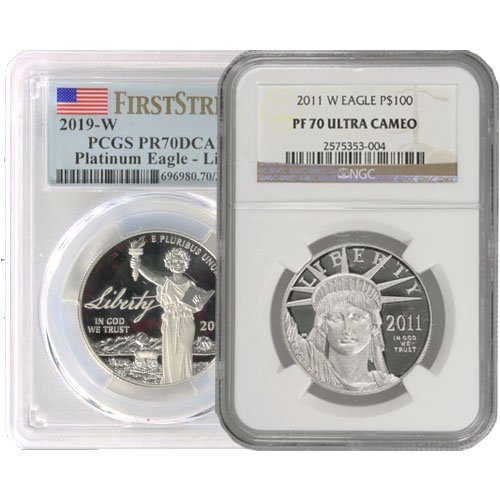
Platinum’s broad demand is its strength as an investment. No single industry dominates it, so a downturn in one sector does not sink the price the way it can for palladium. Jewelry alone takes a large share every year, and investment demand grows whenever gold gets expensive — platinum has spent most of recent years trading well below gold, which makes it look cheap to buyers priced out of gold.
What Is Palladium?
Palladium is platinum’s lighter, rarer-feeling cousin — same silvery-white family, but at 12.02 g/cm³ it is barely more than half platinum’s density, so a 1 oz palladium coin feels noticeably lighter in hand. It was discovered in 1803 by the English chemist William Hyde Wollaston, isolated from platinum ore.
Palladium’s story is the auto industry. More than 80% of global palladium demand goes into catalytic converters for gasoline-powered vehicles, where it cleans exhaust gases. That single-industry dependence is both its opportunity and its risk: when car production booms or supply is threatened, palladium’s price can soar — and when auto demand cools, it can fall hard. Its price shot past $3,440 per troy ounce in March 2022 after Russia’s invasion of Ukraine raised alarms about supply; it has since fallen back substantially. (USGS annual averages tell the same story: palladium averaged $2,419/oz in 2021 and an estimated $1,100 in 2025.)
The U.S. Mint’s palladium coin is the American Palladium Eagle, first released in 2017 under the American Eagle Palladium Bullion Coin Act of 2010 — the newest addition to the American Eagle series. It contains one troy ounce of .9995 fine palladium and carries a $25 face value. Both sides come from the sculptor Adolph A. Weinman: the obverse is his Winged Liberty, the design from the 1916 Mercury dime, and the reverse adapts his eagle from the 1907 American Institute of Architects gold medal. Bullion versions were struck only in 2017 and 2021 (the 2017 issue of 15,000 coins sold out on release day); other years the Mint makes collector finishes only. (American Palladium Eagle guide)
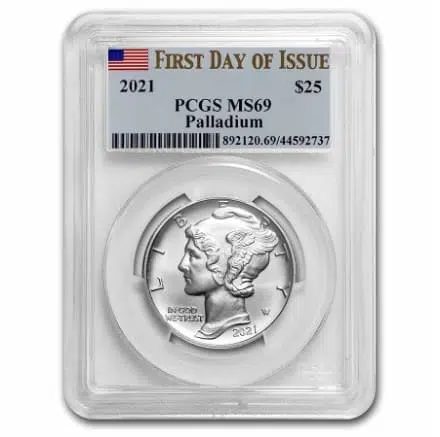
Palladium appeals to a different kind of buyer than platinum: someone comfortable with higher risk in exchange for sharper price movements. It is a bet on cars, not a bet on precious metals in general.
Platinum vs Palladium: How They Feel in Hand
Put a 1 oz platinum coin and a 1 oz palladium coin side by side and they look alike — both silvery-white, both 1 troy ounce. Pick them up and the difference is immediate: platinum is dense and substantial, palladium is light. Platinum’s density (21.45 g/cm³) against palladium’s (12.02 g/cm³) means the platinum coin is smaller and heavier-feeling for the same weight of metal.
For jewelry that difference matters — platinum’s heft reads as luxury, palladium’s lightness as comfort. For investment it matters not at all: you are buying an ounce of metal either way. But it is a useful reminder that these are different metals, not two names for the same thing.
Price Behavior: Steady vs Volatile
This is the biggest practical difference between the two metals, and the one that should decide your first buy.
Platinum is the steadier metal. Its price has typically ranged between about $800 and $1,300 per troy ounce over the past five years, moving with industrial demand and the gold price rather than spiking on single events. USGS annual averages put platinum at $1,094/oz in 2021 and an estimated $1,200 in 2025 — a calm, narrow band.
Palladium is the volatile metal. Its price surged from around $500/oz in 2016 to more than $3,400/oz in March 2022, then fell back sharply as auto demand expectations changed. USGS annual averages: $2,419/oz in 2021, an estimated $1,100 in 2025. That is a round trip most investors are not prepared for.
Neither metal’s past price is a promise about its future — but the pattern is consistent: platinum moves like a precious metal, palladium moves like an industrial commodity with a single customer. If you want a holding you can forget about for five years, platinum’s steadiness is the better fit. If you want to trade an industrial cycle, palladium is the sharper tool.
All prices in this section are historical averages from USGS data, not today’s prices. Always check the live spot price before you buy — the shop lists current prices for every product.
Premiums: What You Actually Pay Over Spot
Neither metal sells at spot. You pay spot plus a premium — minting, distribution, and dealer margin — and the premium gap between the two metals is real.
Palladium consistently trades at a higher premium over spot than platinum, driven by its scarcity and limited supply of investment products — there are simply fewer palladium coins and bars made, and fewer dealers stocking them. Platinum premiums tend to be lower, making it a more accessible entry point.
As a rule of thumb, expect to pay a smaller premium over spot for a 1 oz platinum coin or bar than for the equivalent palladium product. The exact gap moves day to day — compare the live prices in our shop before you decide.
A quick illustrative example (not today’s prices): if platinum spot were $1,200/oz and the premium on a 1 oz Platinum Eagle were 5%, the coin would cost about $1,260. If palladium spot were $1,100/oz with an 8% premium, the Palladium Eagle would cost about $1,188. The cheaper metal is not always the cheaper coin — premium matters as much as spot.
Liquidity: Which Metal Is Easier to Sell?
Platinum wins on liquidity, and it is not close. Platinum is bought and sold by far more dealers, in far more countries, in far larger volumes. Any bullion dealer will buy a 1 oz Platinum Eagle or a recognized platinum bar on the spot. Platinum’s jewelry and industrial markets give it buyers beyond the investment world.
Palladium’s market is thinner. Fewer dealers stock it, fewer buyers want it, and you may find it harder to sell quickly — especially in a falling market, when the buyers who do exist step back. The Palladium Eagle’s low mintages (15,000 for the 2017 bullion issue) make it interesting to collectors, but collector interest is not the same as dealer liquidity.
If you ever need to sell fast, platinum moves first. If you buy palladium, buy it knowing you may need patience — or a specialist dealer — to exit.
Are Platinum and Palladium IRA Eligible?
Yes, both are. The IRS requires platinum and palladium in a precious metals IRA to be at least .9995 fine — and both American Eagles are exactly .9995 fine, so both qualify. The same .9995 standard applies to bars: look for .9995 or higher on the bar’s stamp. (Gold and silver IRAs use different minimums — .995 for gold, .999 for silver — so do not mix up the numbers.)
Platinum vs Palladium: Which Should You Buy First?
There is no single right answer — but there is a right answer for you:
- Buy platinum first if: you want the steadier, more liquid white metal; you prefer lower premiums; you like the idea of a metal with jewelry, medical, and industrial demand behind it; or this is your first step beyond gold and silver.
- Buy palladium first if: you understand the auto industry drives its price, you are comfortable with sharp moves in both directions, and you want a rarer metal with more upside if car production surges.
- Buy both if: you are diversifying across the precious metals. A small position in each — say, one 1 oz coin of each — gives you exposure to both stories without betting the stack on either.
If you are still torn, here is the tiebreaker: look at today’s live prices for the 1 oz American Platinum Eagle and the 2021 1 oz American Palladium Eagle in our shop, and start with the metal whose total price — spot plus premium — makes sense for your budget. Then, when you buy your second white-metal ounce, buy the other.
For the full picture of how the four precious metals compare, see how gold and silver stack up in our companion guide: Gold vs Silver 2026 on Bullion Bridge.
How to Buy Platinum or Palladium
New to white metals? The process is the same as buying gold or silver, and our complete guide to buying gold in 2026 walks through the buying process step by step — the same dealer checks, premium math, and storage rules apply. The short version:
- Check the live spot price first. Platinum and palladium each have their own spot price, separate from gold and silver. If you do not know spot, you cannot tell a fair price from a bad one.
- Compare the total price, not just the premium. Compare the out-the-door price of the exact coin or bar across two or three reputable dealers.
- Buy from a dealer with transparent pricing, insured shipping, and a clear buyback policy. Avoid sellers with no phone number, prices far below everyone else, or pressure to wire money to a personal account. For palladium especially, confirm the dealer will buy it back — a dealer who sells palladium but will not buy it back is a warning sign.
- Verify on arrival. Check the coin or bar matches what you ordered — correct weight, design, and packaging — and keep it in its capsule or assay card.
- Store it properly. A home safe works for a coin or two; for a growing stack, consider a bank safe deposit box or professional vault storage.
Frequently Asked Questions
Is platinum or palladium better for investment?
Neither is automatically better — it depends on what you want. Platinum is generally preferred for long-term stability and liquidity; palladium is the higher-risk play, driven heavily by automotive demand. (palladium vs platinum investment guide)
Is platinum rarer than palladium?
Both are far rarer than gold in annual mine supply — about 190 tonnes of platinum and 210 tonnes of palladium a year, against roughly 3,000 tonnes of gold. Palladium’s above-ground investment stock is smaller, which is one reason its premiums run higher.
Why is palladium more volatile than platinum?
More than 80% of palladium demand comes from one industry — gasoline car catalytic converters — so its price swings with auto production and supply scares. Platinum’s demand is spread across diesel catalysts, jewelry, medical, and industrial uses, which steadies it.
Are platinum and palladium IRA eligible?
Yes, both — at .9995 fineness, which is exactly the IRS minimum for platinum and palladium. Both American Eagles qualify.
Which white metal has the lowest premium?
Platinum, usually — its premiums over spot tend to be lower than palladium’s. But the gap moves day to day, so compare live prices before you buy.
Ready to Buy Your First White Metal?
Gold and silver may be the headline metals, but platinum and palladium are where the overlooked value sits — rarer than gold, essential to industry, and trading at a fraction of gold’s price. Whether you pick platinum’s steadiness or palladium’s upside, you are starting with a real precious metal, not a speculation on paper. Browse platinum and palladium in our shop — recognized mints, transparent pricing tied to live spot, and insured delivery on every order.
This article is for education only and is not financial advice. Platinum and palladium prices move with their own live spot markets — always check the current price before you buy.